


For the first quarter of fiscal 2026 (April to June 2026), Toyota Motor posted revenue of 13.5 trillion yen (approximately 577.88 billion yuan), up 10.4% year on year; over the same period, its operating profit fell 8.8% to 1.1 trillion yen (approximately 47.09 billion yuan). Toyota disclosed the above data in its quarterly financial report released on August 4.
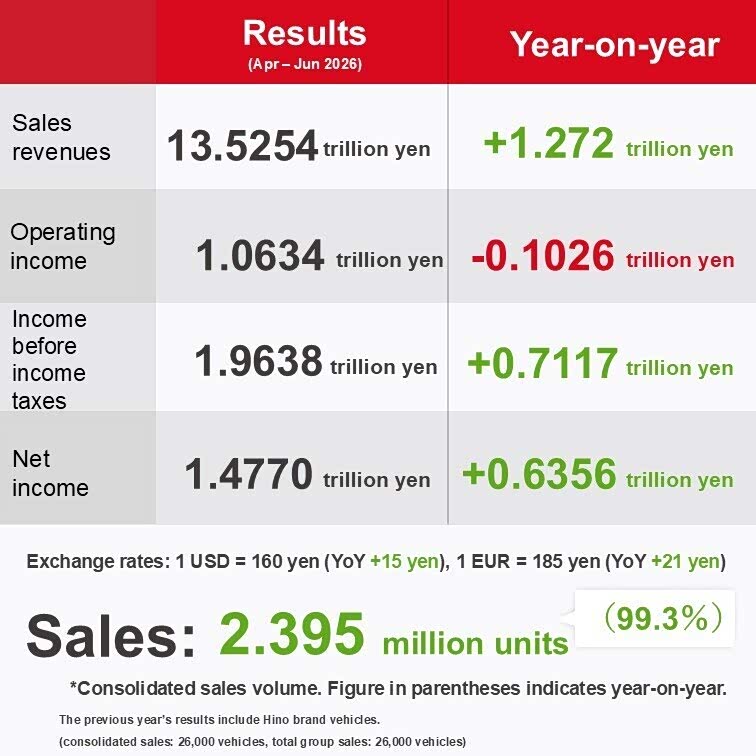
Toyota stated that the situation in the Middle East has exerted a negative impact on the company's operations. Normally, Toyota exports about 500,000 vehicles to the Middle East each year, and the company originally estimated that its exports to the region in fiscal 2026 (April 2026 to March 2027) would be halved. Toyota revised its forecast in the first-quarter report. The company believes that through diversified measures such as opening up alternative logistics routes, the year-on-year decline in Toyota's sales in the Middle East will narrow to about 25%.
Buoyed by the favorable factor of yen depreciation and its response measures to the Middle East situation, Toyota has raised its revenue and operating profit forecasts for fiscal 2026 by 3 trillion yen (approximately 128.4 billion yuan) and 400 billion yen (approximately 17.12 billion yuan) respectively.
Toyota expects its total vehicle sales in fiscal 2026 to reach 11.18 million units, with total revenue of 54 trillion yen (approximately 2.3 trillion yuan), up 7% year on year; its operating profit will stand at 3.4 trillion yen (approximately 145.52 billion yuan), down 10% year on year.
The external competition facing Toyota still cannot be ignored. Performance data recently released by the company shows that in the first half of 2026, Toyota's global sales fell 2.8% to 5.39 million units. Specifically, sales in the Japanese domestic market rose 4.4% year on year to 1.095 million units, while sales in overseas markets fell 4.5% year on year to 4.295 million units.
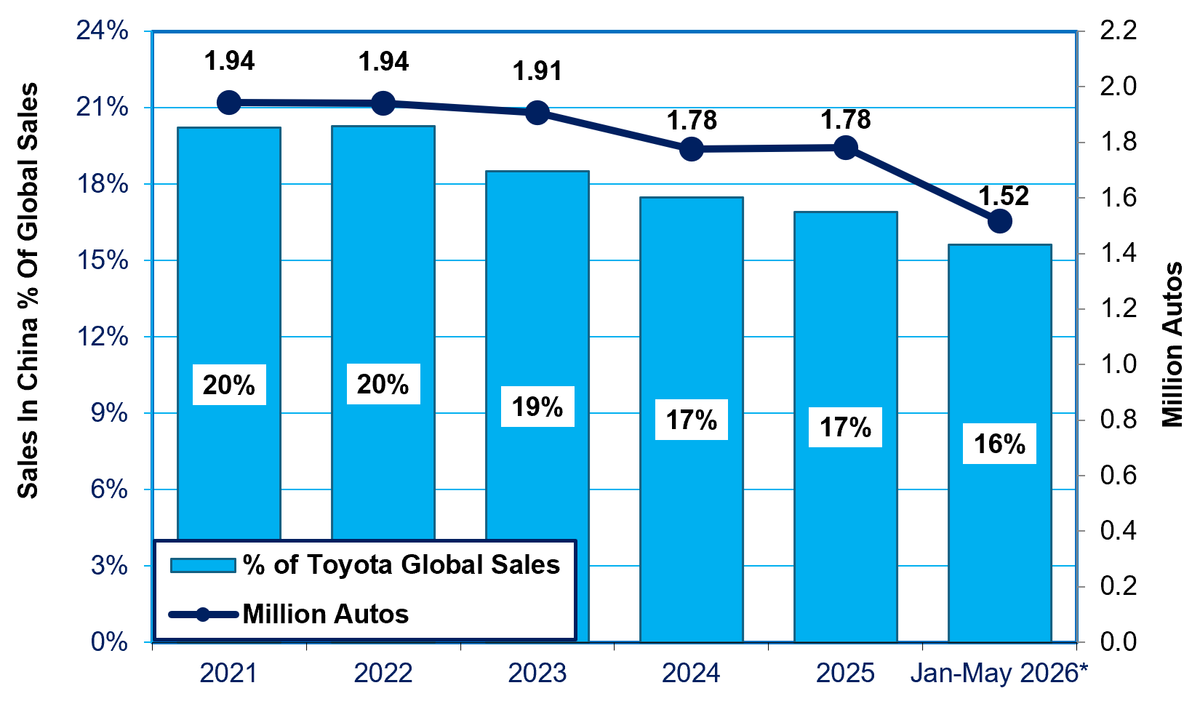
The performance in the Chinese market is particularly noteworthy. In the first half of 2026, Toyota's sales in China plummeted 17.1% year on year to 695,000 units, with the sales decline in the second quarter hitting 28%. Toyota also feels pressure in overseas markets actively expanded by Chinese automakers, such as Southeast Asia and Oceania.
Toyota stated that the overall domestic passenger vehicle sales in China fell by about 20% year on year in the first half of 2026, and the decline of fuel-powered vehicles reached 34%. The performance of Toyota's fuel-powered vehicles is within a reasonable range, but the shrinking market size has dragged down its performance. Going forward, Toyota plans to carry out joint R&D with local Chinese partners to improve the competitiveness of its fuel-powered vehicles and battery electric vehicles.

In response to the expansion of Chinese automakers in overseas markets, especially in the Asian market, Toyota said that some dealers that originally represented Japanese brands have switched to the camp of Chinese automakers, but Toyota will still stick to its own channel network and explore its differentiated advantages over Chinese automakers, such as making full use of auto finance tools to improve the competitiveness of products throughout their life cycle.
An unnamed auto industry insider said that the financial penetration rate in overseas markets is generally higher, and models such as car loans and financial leasing require the participation of financial institutions, so both automakers and dealers can earn extra income through financial services. Japanese automakers usually go overseas in tandem with financial institutions such as banks, which allows them to give full play to this advantage. At present, Chinese automakers mainly rely on the competitiveness of their products, and the profit margins of automakers and dealers are highly dependent on new car sales, which may face pressure in markets that focus on the residual value of used cars.
Japan's NHK recently broadcast a documentary titled *Inside Toyota*, which tells the development process of Toyota's new-generation product platform and the new Corolla, and shows how much Toyota attaches importance to the competitive pressure from Chinese automakers.
A Toyota R&D staff said that Toyota is gradually losing to China on a global scale, and new product development must catch up with the speed of Chinese automakers. Only by finding a way to win can Toyota survive.
Toyota has adopted multiple measures to shorten the product development cycle, for example, changing the original practice of developing three generations of prototypes to one-off development, and adjusting the process of developing the product platform first before developing the body of specific models to simultaneous development. "The old method doesn't work anymore," said the Toyota R&D staff. "We must push the limits on the premise of ensuring quality, otherwise the gap between us and Chinese automakers in new product iteration will become wider and wider, and we will eventually be unable to participate in market competition."
Toyota will dismantle and study benchmark new vehicles around the world. The documentary shows that the models Toyota studies for benchmarking include Chinese products such as BYD Qin and Zeekr 007, as well as products from automakers such as Tesla and Porsche.
Toyota's new product platform is planned to be compatible with multiple technical routes, including fuel power, hybrid power and battery electric power. Toyota believes that the company and the industry were previously overly optimistic about the popularization speed of battery electric vehicles, and flexibly adjustable platforms and production systems are of vital importance.
Toyota's latest quarterly financial report has raised its full-year sales target for hybrid electric vehicles, and slightly lowered its sales forecasts for battery electric vehicles and plug-in hybrid electric vehicles.
In the documentary, Toyota's Chairman Akio Toyoda said that the company will continue to face external challenges such as competitors and technological changes, but the real risk comes from the internal belief that the company is already flawless. The moment an enterprise thinks it has reached its peak is the beginning of its decline.