


【AUTOHOME Industry】Recently, Thailand's new energy vehicle (NEV) market has slumped amid policy transition. Data released by the Federation of Thai Industries (FTI) on March 24 showed that the sales of battery electric passenger vehicles in Thailand fell 18.6% year-on-year to 6,168 units in February, an 80% drop from 31,000 units in January. However, the market has rebounded sharply in recent months. The number of new battery electric vehicle (BEV) registrations in Thailand hit 22,275 units in June, a year-on-year increase of as high as 140%. According to cumulative data for the first half of the year, total new vehicle sales in Thailand reached 346,966 units, up 15% year-on-year; of which cumulative BEV sales stood at 104,418 units, up 93% year-on-year. The growth rate of BEVs remains far higher than that of the overall market.
Thailand is a key market for China's NEV exports. Data from AutolifeThailand showed that Thailand's BEV sales reached 122,000 units in 2025, and among the top 10 best-selling models, only Tesla Model Y is a non-Chinese brand model. The slump in Thailand's NEV market means Chinese automakers face more challenges.
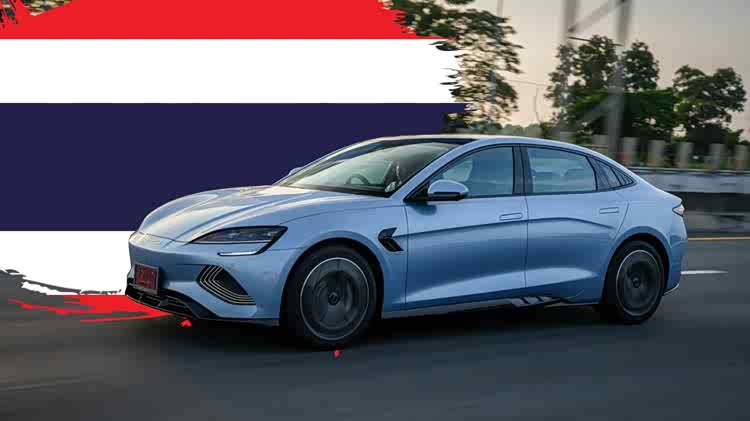
Thailand launched the "EV3.0" NEV subsidy policy in 2022. Chinese automakers including BYD seized the opportunity to enter the market rapidly, and Thailand's NEV market started to boom that same year. Data from market agency AutolifeThailand showed that Thailand's EV sales were less than 2,000 units in 2021, rose to 9,729 units in 2022, and exceeded 70,000 units in 2023.
The "EV3.0" incentive program expired at the end of January 2026, and the "EV3.5" scheme was rolled out starting in February. The key change is that under the new policy, the maximum subsidy for EVs plummeted from 150,000 baht to 50,000 baht, and the subsidy is only applicable to models produced locally in Thailand.
In January, multiple automakers rushed to boost sales ahead of the policy change, which overdrew subsequent market demand. Surapong Paisitpattanapong, spokesperson for the Automotive Industry Club of the Federation of Thai Industries, publicly stated at a monthly press briefing that after the Thai government terminated the maximum 150,000 baht EV purchase subsidy, demand for EVs dropped sharply.
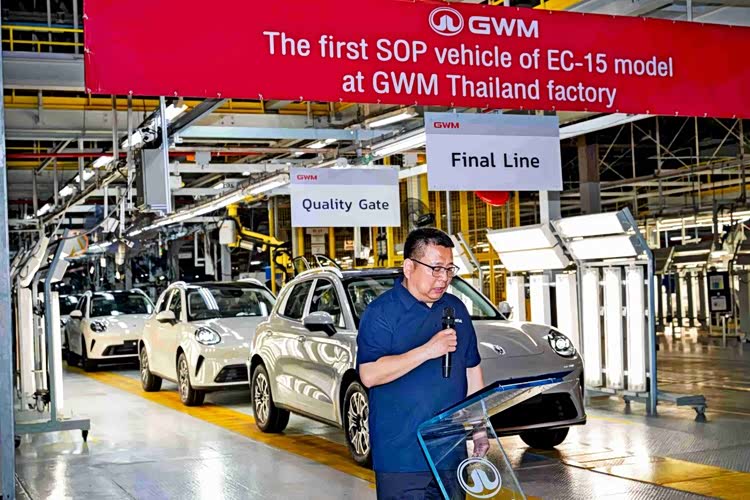
The 47th Bangkok International Motor Show officially kicked off on March 23. More than 10 Chinese automakers including BYD, Chery Automobile, GAC Group and Great Wall Motors participated in the exhibition, accounting for nearly half of the total booths. The period around the auto show is usually a peak sales season. Recently, automakers have launched new products and stepped up promotions to seize sales opportunities.
For example, BYD displayed more than 40 models at this auto show, including 4 brand-new models. In terms of promotions, the entry-level version of BYD's best-selling model Dolphin in the Thai market was cut from 599,900 baht to 509,900 baht during the auto show promotion period, a price reduction of 15%.
In addition, the conflict in the Middle East has pushed up international oil prices, bringing new variables to the NEV market.
*Automotive News Europe* recently reported that after the outbreak of the Middle East conflict, British consumers are worried about the continuous rise of gasoline prices, and EVs have become highly sought after. On the German auto e-commerce platform MeinAuto, search volume for EVs increased by 40%. A survey of German consumers conducted by another auto e-commerce platform Carwow showed that 48% of respondents believed that soaring fuel prices would push them to consider buying EVs or hybrid vehicles. (See Caixin's report "Domestic refined oil prices raised consecutively, will it help the NEV market recover?" for details)
Surapong Paisitpattanapong said that driven by rising fuel prices, demand for EVs is expected to rebound in the coming months.
A former SAIC Motor executive in charge of Thai business said that after the outbreak of the Russia-Ukraine conflict in early 2022, retail oil prices in Thailand nearly doubled at their peak, and the cost of using fuel vehicles rose sharply accordingly, which also encouraged consumers to try NEVs.