


[AUTOHOME Industry]. Thailand is Southeast Asia's biggest auto production centre and an export base for some of the world's top carmakers, including Toyota (7203.T). Buy now, things changed. Let's look at the June's sales market.
Power Structure: BEV Doubles Growth, Electrification Accounts for Over 60%, while Fuel Vehicles Remain Solid in Pickup and Commercial Vehicle Segments
The power structure of new vehicles in Thailand in June presents an obvious electrification-led feature. Registrations of pure electric BEVs reached 22,275 units, up 140% year-on-year, accounting for 37.9% of the overall market; HEV hybrids recorded about 14,378 units, accounting for around 24.5%; PHEV plug-in hybrids stood at about 2,329 units, accounting for roughly 4.0%. The combined share of the three "electrified" models (BEV+HEV+PHEV) hit 66.5%, meaning that for every 3 new vehicles sold, about 2 are electrified models.
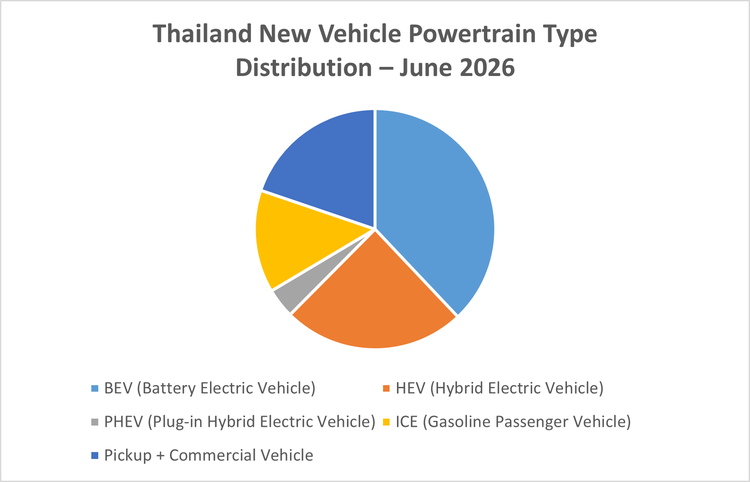
Traditional internal combustion engine passenger vehicles (ICE passenger) only registered 8,114 units in June, down 34% year-on-year, accounting for 13.8%. However, it is worth noting that the decline of ICE models does not occur evenly across all market segments -- pickups and commercial vehicles (Pickup+CV) still maintain a volume of about 11,628 units, taking up 19.8% of the market. This segment is less impacted by electrification, and is mainly driven by commercial demand and economic prosperity. According to the cumulative data of the first half of the year, the total sales volume of new vehicles in Thailand reached 346,966 units, up 15% year-on-year; among them, cumulative BEV sales hit 104,418 units, up 93% year-on-year. The growth rate of BEVs is still far higher than that of the overall market, but whether it can be maintained in the second half of the year depends on the actual implementation pace of the EV3.5 subsidy, supply of new models, and the counterattack intensity of Japanese hybrid models.
II. Top 10 Brands: Toyota Holds the Top Spot, BYD Ranks Top 3, Chinese Brands Occupy Five Positions
The top 10 brands in Thailand's sales volume in June present a pattern of "Japanese brands on the defensive, Chinese brands on the offensive". Toyota continued to rank first with 21,791 units (+5.2%), but its growth rate has slowed down significantly. Honda ranked second with 6,234 units (+1.5%), and Isuzu ranked third with 5,030 units (-3.1%) -- the decline of Isuzu mainly reflects fluctuations in the pickup market, rather than the competitiveness of its passenger vehicles.

BYD ranked fourth with 4,832 units (5,066 units if Denza's 234 units are included). Mitsubishi ranked 7th with 2,026 units (+8.0%), and Tesla ranked 9th with 1,626 units (-12.0%). Chinese brands occupy five positions among the top 10: BYD (4th), MG (5th, 3,063 units, +45.0%), GAC (6th, 2,188 units, +120.0%), Geely (8th, 1,997 units, +350.0%), Jaecoo & Omoda (10th, 1,485 units, +280.0%).
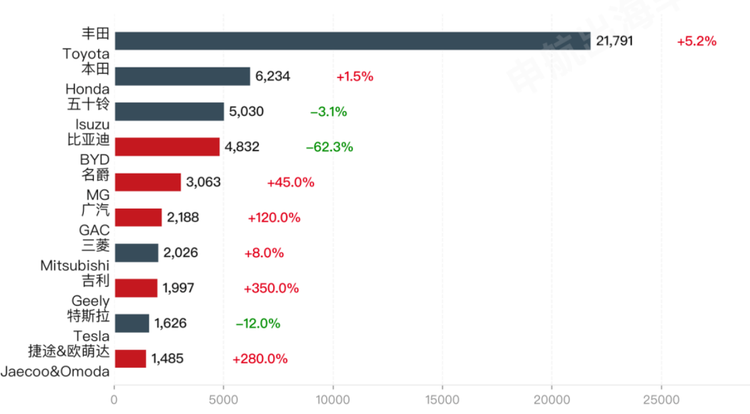
According to statistics based on the country/region where brand headquarters are located, the share of Japanese brands dropped from about 74.0% in June 2025 to 62.4% in June 2026, while the share of Chinese brands rose from about 13.0% to 34.7%. The decline of Japanese brands and the rise of Chinese brands are not strictly a zero-sum game -- Toyota and Honda still maintain advantages in the hybrid and pickup segments, and Chinese brands mostly expand rapidly in the BEV incremental market, with competition overlapping concentrated in some urban SUV and sedan segments. In terms of competitive substitution relationship, Chinese brands mainly erode the share of the second echelon of Japanese brands and some fuel vehicle segments, rather than the core market base of Toyota and Honda.
Judging from the June data, Nissan and Mazda have fallen out of the top 10. Although Mitsubishi ranks 7th with 2,026 units, its year-on-year growth is only 8.0%, far lower than the average growth rate of Chinese brands. In terms of commercial driving factors, the rapid growth of Chinese brands is inseparable from the combined effect of localized production, financial support and channel expansion. Chinese automakers such as BYD, Great Wall Motor, GAC and Neta have built factories or promoted local assembly in Thailand, enabling them to enjoy localized subsidy preferences in Thailand's EV policies and shorten delivery cycles; the penetration rate of auto loans in Thailand exceeds 60%, and Chinese automakers have cooperated with local financial institutions to launch low down payment and low interest rate schemes, which significantly reduces the threshold for car purchase; on the channel level, the number of BYD showrooms has expanded rapidly from about 10 in 2025, and brands such as Geely, Deepal and Jaecoo have also rapidly expanded their presence through dealer networks. The combination of these factors enables Chinese brands to move from "new product introduction" to "large-scale volume release" in a short period of time.
III. Model Ranking: Chinese Brands Occupy 9 of the Top 10 BEV Spots, Geely EX2 Tops the List, Model Y Becomes the Only Non-Chinese Brand
BEV Models: Almost Dominated by Chinese Brands
Among the top 10 best-selling BEV models in Thailand in June, Chinese brands occupy 9 spots, with Tesla Model Y being the only non-Chinese brand. Geely EX2 topped the list with 1,668 units, followed by MG S5 (1,159 units), BYD Atto 3 (1,146 units), Deepal S05 (1,115 units) and MG4 Electric (1,090 units) ranking 2nd to 5th respectively. The total sales volume of the top 10 models was about 11,859 units, accounting for 53.2% of the total BEV sales in the month.
This pattern indicates that Thailand's BEV market has become highly "Sinicized", but "high Sinicization" does not mean "Chinese brands are invincible". Model Y ranks 6th with 979 units. It remains in the top 10 without any local factory, relying on imports and with a significantly higher price range than Chinese brands, indicating that there is still room for differentiation in the high-end BEV market. In addition, Japanese and Korean BEVs have not really made efforts in the Thai market yet. With the increased launch of models such as Toyota's bZ series and Hyundai's IONIQ series in the second half of the year, the pattern of the top 10 BEVs may change.
Pickup and Overall Market: Toyota Hilux Remains the Invisible Champion
If we only look at the passenger vehicle brand ranking, Toyota's sales in June were about 16,599 units; after adding pickups (mainly Hilux), Toyota's total new vehicle sales reached 21,791 units. This means that Hilux pickups account for about 23.8% of Toyota's sales in the month, and it is a pillar model that cannot be ignored in the Thai market. The electrification process of the pickup market lags significantly behind that of passenger vehicles. This is not only a traditional advantage area for Japanese brands, but also a blue ocean that Chinese electric pickups (such as BYD Shark, Great Wall Shanhai Poer HEV, etc.) may enter in the future.
IV. Chinese Brands: BYD Leads the Way, Geely/GAC/Jaecoo Record Impressive Growth Rates
In June, the total sales volume of Chinese brands in Thailand's new vehicle market was about 20,379 units (calculated by brand nationality), accounting for 34.7% of the overall market. If sub-brands such as Denza are included, BYD Group recorded about 5,066 units in the month, remaining the top Chinese brand. It should be noted that BYD's sales fell 62.3% year-on-year in June, which was mainly affected by the high base before the expiration of the EV3.0 subsidy in June last year; on a month-on-month basis, the figure in June was basically flat compared with 5,030 units in May, indicating that it has found a relatively stable monthly sales range under the new policy environment.
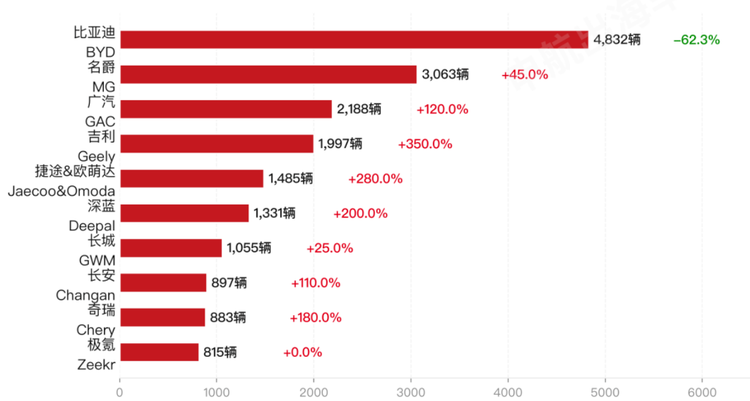
There is obvious differentiation among Chinese brands. Geely saw a year-on-year increase of 350.0%, Jaecoo & Omoda +280.0%, Deepal +200.0%, Chery +180.0%, GAC +120.0%, Changan +110.0%, all with very impressive growth rates; while BYD showed negative growth due to the base effect. This differentiation reflects the product cycle stages of different brands: new models such as Geely EX2, Deepal S05, Jaecoo & Omoda are in the volume release period after launch, while BYD's main models Atto 3 and Dolphin have been launched for a long time, and are facing diversion from new products at the same price range.
BYD sold a total of about 25,890 units in Thailand in the first half of the year, remaining the best-selling Chinese brand in the Thai market. Its monthly trend showed sharp fluctuations: it surged to 12,791 units in January before the expiration of EV3.0, dropped sharply to an average of about 1,100 units per month from February to April due to the policy vacuum period and off-season factors, and rebounded to about 5,000 units in May and June with the adjustment of new models and promotion rhythm.
BYD Model Structure: Yuan PLUS Remains the Main Force, Seal and Seagull Have Smaller Volumes
In BYD's sales structure in Thailand in June, Yuan PLUS (Atto 3) accounted for 24.7% of the brand's sales with 1,146 units, Dolphin accounted for 18.5% with 857 units, and Song PLUS accounted for 17.5% with 812 units. The three models together accounted for 60.7% of the brand's total sales. Models such as Sea Lion 07 (467 units), Yuan UP (412 units), Seal (344 units), Seagull (298 units) and M6 (298 units) have relatively small volumes. It can be seen that BYD currently still relies on the three earlier introduced models of Atto 3, Dolphin and Song PLUS in Thailand, and new models such as Sea Lion 07 and Seal have not yet formed scale effects.
V. Core Judgments: Electrification is the Long-term Direction, but Short-term Pattern is Disturbed by Both Policy and Supply
First, Thailand's auto market is undergoing the most aggressive electrification transformation in Southeast Asia, but the 66.5% electrification penetration rate needs to be interpreted with caution. It is a fact that the combined share of BEV+HEV+PHEV reached 66.5% in June, but HEV contributed about 24.5 percentage points, while PHEV only contributed 4.0 percentage points. The rapid growth of HEV largely benefits from the localized production and price reduction of hybrid models of Toyota and Honda in Thailand, which is different from China's "pure electric-led" path. It is not accurate to simply regard Thailand as "the second Chinese market", as its electrification structure is more driven by the dual wheels of "hybrid + pure electric".
Second, the growth of Chinese brands mainly comes from the BEV incremental market, and the impact on the core base of Japanese brands is still limited. Chinese brands occupy 9 of the top 10 BEV spots and 5 of the top 10 brand spots, with remarkable results. However, Toyota, Honda and Isuzu still firmly occupy the top three positions, and their advantages mainly come from hybrid and pickup segments -- which are precisely the areas where Chinese brands are currently weak or have not yet entered on a large scale. Therefore, the breakthrough of Chinese brands in Thailand is concentrated in the urban passenger vehicle BEV market, and the direct replacement objects are mostly the second echelon of Japanese brands such as Mitsubishi, Nissan and Mazda, as well as some fuel vehicle shares, and have not yet formed a full-category replacement for Toyota and Honda.
Third, BYD is under short-term pressure, but is still expected to remain the top Chinese brand for the whole year. The 62.3% year-on-year decline in June is caused by the base effect, and the month-on-month performance has stabilized at about 5,000 units in May and June. With a cumulative sales volume of 25,890 units in the first half of the year and a BEV market share of about 24.8% (about 26,000 units out of 104,418 units), BYD remains the leader in Thailand's BEV market. However, facing the competition from new products of Geely, Deepal, GAC and other brands, BYD needs to accelerate the introduction of new models and the progress of localized production, otherwise its leading advantage may gradually narrow. Fourth, pickups are a possible next breakthrough for Chinese brands, but they also face challenges from policies and market habits. Pickups account for about 20% of Thailand's new vehicle market, and are currently the segment with the lowest electrification rate.
Models such as BYD Shark and Great Wall Shanhai Poer HEV have entered or are about to enter Thailand, but pickup users are highly sensitive to durability, maintenance network and used car residual value, and Chinese brands have not yet established a reputation in this field. The pace of pickup electrification may be slower than that of passenger vehicles.
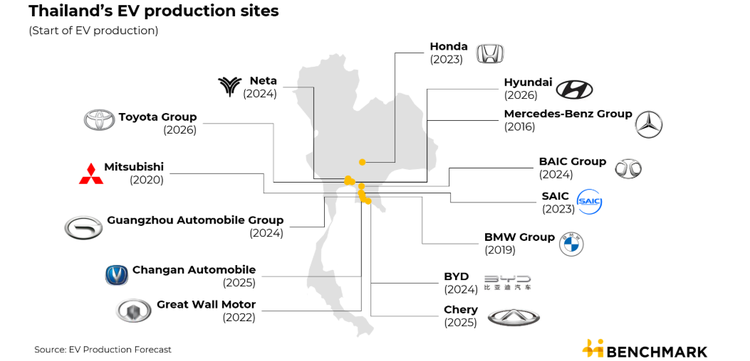
Fifth, the policy window is still a key variable affecting short-term sales. The panic buying before the expiration of the EV3.0 subsidy in January 2026 and the wait-and-see attitude before and after the introduction of the EV3.5 policy will amplify the fluctuation of monthly data. In the second half of the year, attention should be paid to: ① the actual details and implementation pace of the EV3.5 subsidy; ② the impact of the Bank of Thailand's interest rate trend on auto loan demand; ③ the launch rhythm of new models (such as Toyota bZ, Hyundai IONIQ, more facelifted models of BYD). These variables are independent and influence each other, so it is not appropriate to explain the market trend with a single logic. Outlook for 2027: Competition will shift from "subsidy-driven" to "localization and product matrix-driven". The official implementation of the EV3.5 policy will raise the threshold for localized manufacturing, and brands that only rely on complete vehicle imports may lose their subsidy eligibility or see their subsidy amount greatly reduced.
This means that automakers with factories or plans to build factories in Thailand (BYD, Great Wall Motor, GAC, Neta, etc.) will gain a sustained cost advantage, while brands that have not yet arranged production capacity may be forced to adjust their price strategies or withdraw.