


[AUTOHOME New Car Launch] On September 7, Xiaomi Pengcheng N70 was officially launched. A total of 2 variants are available, with the Xiaomi Pengcheng N70 Pro priced at RMB 209,900, and the Xiaomi Pengcheng N70 Max priced at RMB 239,900. The new model is a range-extended large 5-seater SUV targeting young family users, with a maximum CLTC pure electric range of 505km, and a usable interior cabin area of 4.01 square meters.
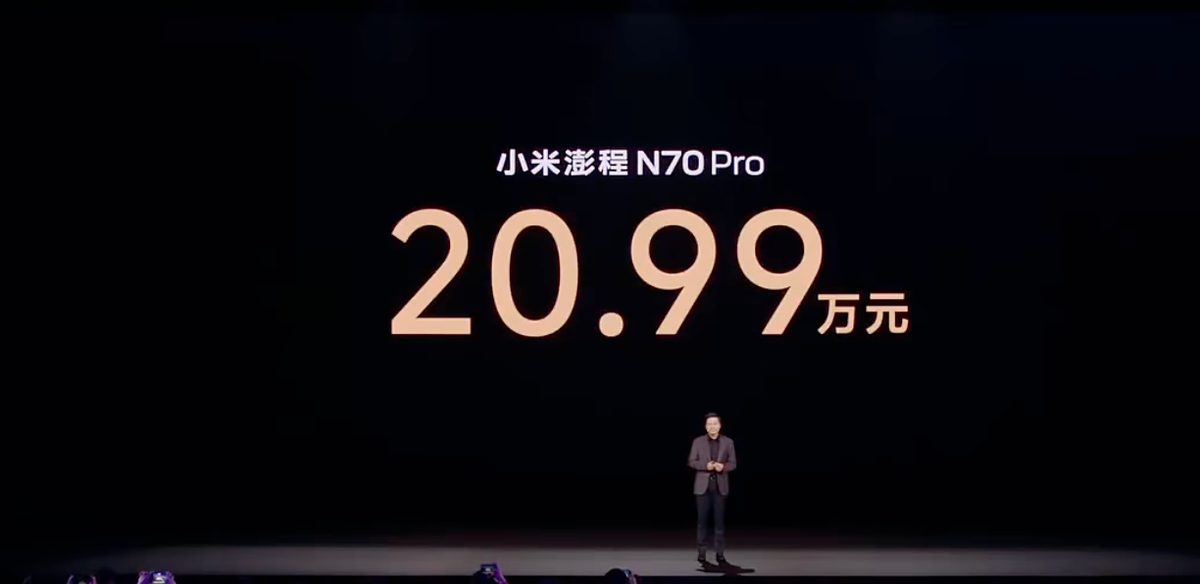
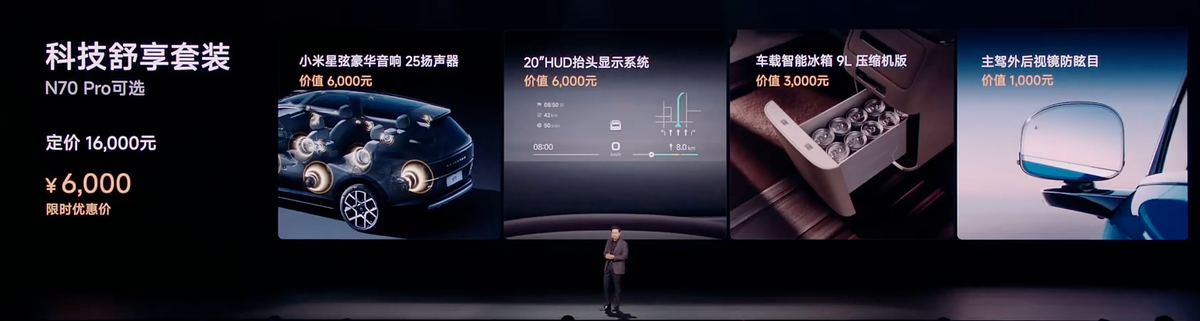


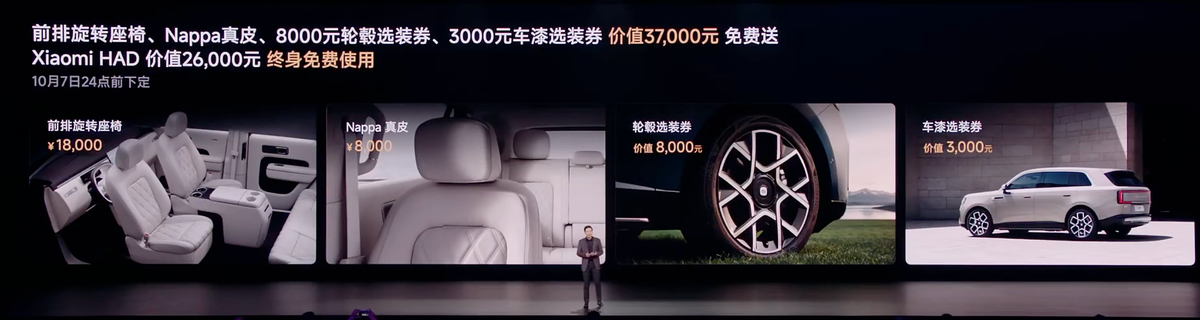


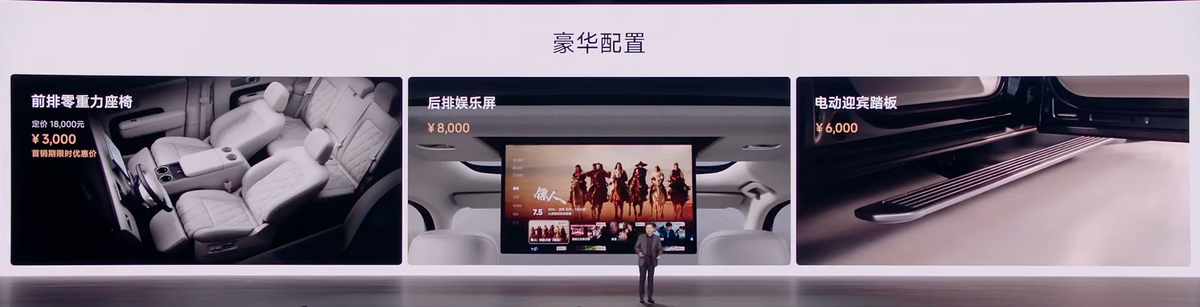
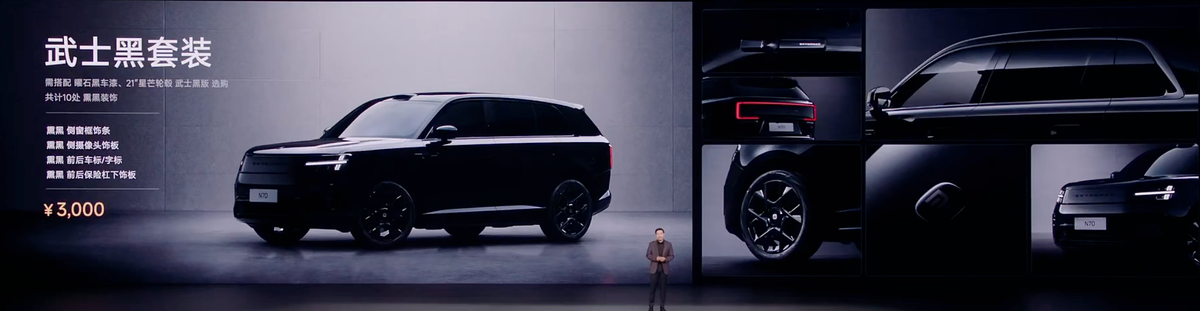
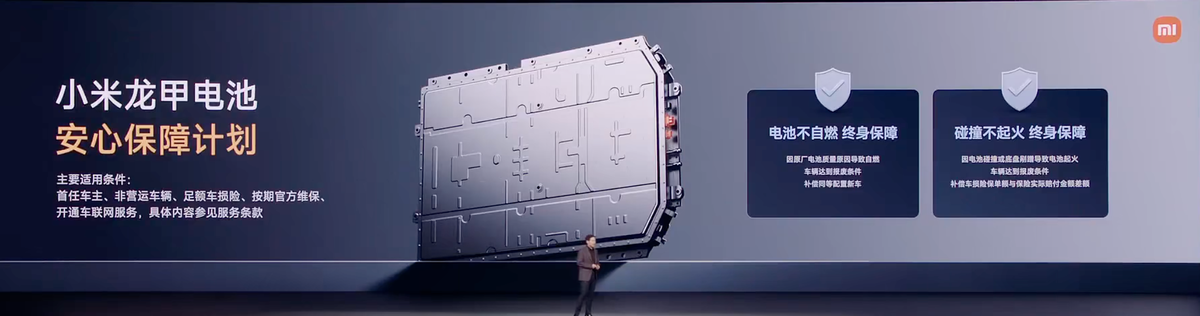
Customers who place orders before 24:00 on October 7 can enjoy launch benefits worth up to RMB 67,000, including swivel front seats, Nappa leather, Xiaomi HAD, 9L compressor refrigerator (only for Max variant), anti-glare driver's side exterior rearview mirror (only for Max variant), rim coupon and paint coupon. Down payment starts from RMB 49,900, with a limited-time 5-year low-interest plan (annualized rate 1.99%) or limited-time easy repayment plan. First-time owners of Xiaomi cars who make an additional purchase or trade-in will be given 20,000 points (valued at RMB 2,000), and existing owners who invite friends to purchase a car will receive a 200 kWh electricity card plus 3,000 points.


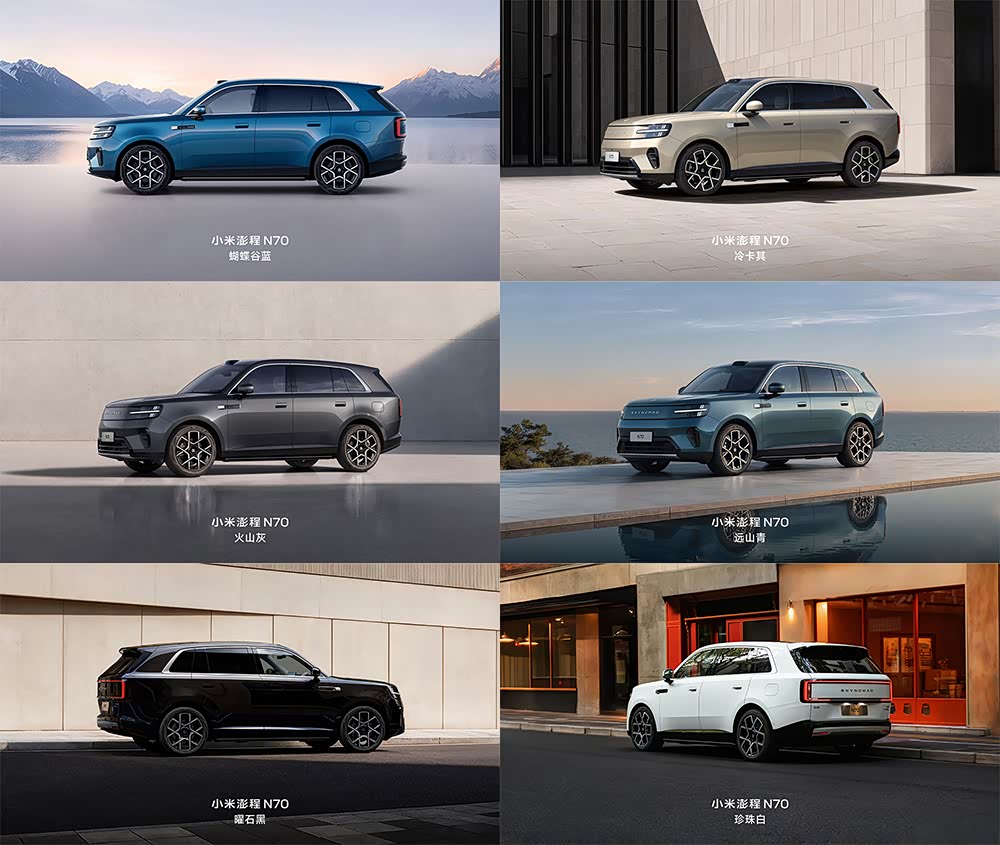
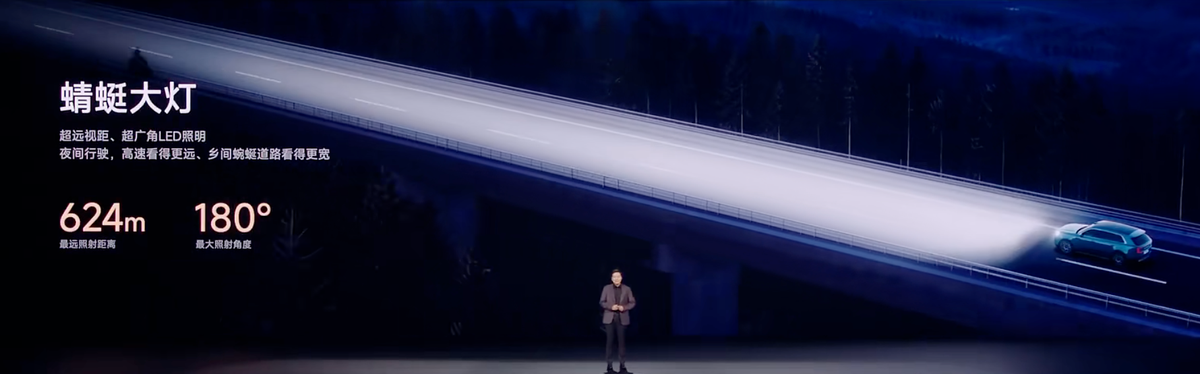
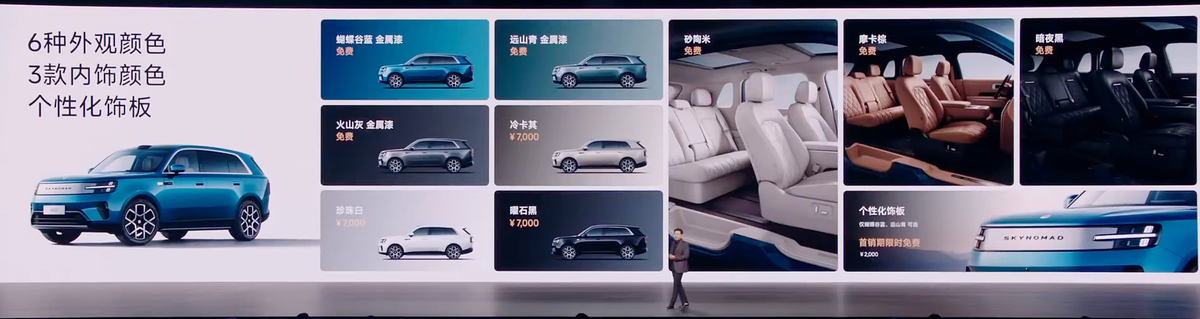
Looking back at the new car, the Xiaomi Pengcheng N70 adopts a brand-new exterior design style. The dragonfly headlamps retain family characteristics while incorporating innovations, with a high beam illumination distance of 605 meters and 180° ultra-wide angle coverage for low beam. In terms of body colors, the new car offers 6 options: Pearl White, Volcanic Ash, Obsidian Black, Distant Mountain Green, Cool Khaki and Butterfly Valley Blue. For Butterfly Valley Blue and Distant Mountain Green, customers can also choose personalized trim panels in body-matching color or silver brushed aluminum.
Moving to the side profile, the new car adopts a short front overhang and long rear overhang design. The LiDAR mounted on the roof adopts a cobblestone shape to enhance aesthetics. In addition, it is equipped with new national standard semi-hidden mechanical door handles, as well as the same floating exterior rearview mirrors as the SU7 and YU7. In terms of dimensions, its length, width and height are 4960/1998/1765 (1785) mm respectively, with a wheelbase of 2950 mm; 1 19-inch rim and 3 21-inch rims are available for selection. At the rear, the new car adopts a brand-new 3D star ring taillight, which has high recognizability when lit.
Moving into the interior, the Xiaomi Pengcheng N70 offers 3 theme color options: Sand Ceramic Beige, Dark Night Black, and Mocha Brown. The front row is equipped with an 8.8-inch LCD instrument cluster, 20-inch head-up display, and 16.1-inch central control screen, built with HyperOS cockpit system and Qualcomm Snapdragon 8650 in-vehicle chip, and comes standard with Super Xiao Ai, which supports in-vehicle dynamic sound zone voice interaction, and out-of-vehicle Xiao Ai voice command on the go. In addition, it adopts a cabinet-style central control design, with built-in storage compartments and hidden drawers.
The front seats are available in three options: massage seats (16-point seat massage), swivel seats and zero-gravity seats, and are also equipped with heating, ventilation and steering wheel heating. When choosing swivel seats, they can realize 180° rotation, supporting face-to-face seating mode, office mode and large bed mode. A sliding central island is installed between the front seats, integrating 4 cup holders, 50W wireless charging, 6.6L storage compartment, 9L compressor refrigerator and ecological interface, etc.
The rear doors of the vehicle can achieve a large opening of nearly 90 degrees. The interior has a fully flat floor with a length of 2.58 meters, with 5 built-in slide rails reaching a maximum length of 1.56 meters. The maximum second-row legroom is 1410mm, and the standard trunk volume is 1203L at this time, which can be expanded to a maximum of 2425L. The rear seats support ventilation and heating functions, and have a built-in 8.5L large drawer. In addition, the vehicle is also equipped with a 25-speaker audio system, 14 positions of 256-color diffuse ambient lighting, 21.4-inch rear entertainment screen, 6.88-inch detachable rear control screen and vehicle-mounted desk, etc.
In terms of safety, high-strength steel and aluminum alloy account for 91.3% of the vehicle body. 14 pieces of 2200MPa ultra-high strength steel across the vehicle form a "built-in roll cage", and it is equipped with an integrated hot-formed door ring, integrated hot-formed front floor frame, 9 airbags and 21 anti-pinch designs. At the same time, the ultra-long slide rails are made of 7-series reinforced aluminum alloy, with a locking strength of 65,000N and a maximum peel strength of 70,000N. In terms of driving assistance, it is equipped with LiDAR + 700TOPS NVIDIA Thor-U chip, adapted to Xiaomi HAD large model, supports high-speed navigation assisted driving, urban navigation assisted driving, and valet parking assisted driving functions, with more anthropomorphic driving performance.
In terms of power, the new car is equipped with a range-extended power system composed of a 1.5T engine. Among them, the Xiaomi Pengcheng N70 Pro adopts a single motor with a maximum power of 210kW, matched with a 52kWh Sunwoda lithium iron phosphate battery, with a CLTC pure electric range of 351km, a CLTC comprehensive range of 1351km, and a WLTC fuel consumption of 5.7L/100km in battery-depleted mode. The new car comes standard with front double wishbone and rear multi-link independent suspension.
The Xiaomi Pengcheng N70 Max adopts a dual-motor four-wheel drive system, with maximum powers of 210kW and 100kW respectively, and a 0-100km/h acceleration time of 5.5 seconds, matched with a 76kWh battery, with a CLTC pure electric range of 505km and a comprehensive range of 1461km. In addition, it is equipped with air springs and continuous damping variable shock absorbers, with a turning radius of 5.67 meters, and a maximum wading depth of 600mm (Xiaomi Pengcheng N70 Pro)/650mm (Xiaomi Pengcheng N70 Max).
Competitors:
Whether from the perspective of product features or guiding price, the Xiaomi Pengcheng N70 seems to be directly targeting the Li Auto L6 and AITO M6. As a latecomer, the Xiaomi Pengcheng N70 has certain advantages in terms of price, space, configuration, range and scenario modes. Next, it remains to be seen whether it can quickly win the favor of young family users. At the same time, how products such as Li Auto L6 and AITO M6 will fight back, and whether they will accelerate the launch of new products, is also worthy of expectation.
Body Size Comparison between Xiaomi Pengcheng N70 and Competitors
Model
Length/Width/Height (mm)
Wheelbase (mm)
Xiaomi Pengcheng N70
4960/1998/1785
2950
Li Auto L6
4935/1960/1735
2920
AITO M6
4960/1985/1736
2950
XPeng G9
4891/1937/1670
2998
Onvo L80
5145/1998/1766
3110
BYD Sea Lion 08
5115/1999/1800
3030
In addition, from the perspective of the overall price range of the Xiaomi Pengcheng N70, its competitors almost cover all large 5-seater SUV models priced between RMB 200,000 and 250,000. Although products including the XPeng G9, Onvo L80 and BYD Sea Lion 08 have different power systems, they will also form a certain competitive relationship due to overlapping price ranges. Whether it can outperform all rivals in the same price segment will also be a key test for the Xiaomi Pengcheng N70 to become a benchmark product.
Editor's Review:
To be honest, I originally thought that by 2026, "affordable and well-equipped" products had developed to a relatively stable level, and it would be difficult for new products to trigger a market boom. However, the Xiaomi Pengcheng N70 is indeed an exception. On the one hand, it has its own built-in traffic and can attract high attention. On the other hand, with ingenious designs such as ultra-long slide rails and swiveling front seats, it has indeed brought scarcity to the current market. So will its arrival trigger a small revolution in the household SUV market? Can ultra-long slide rails and swiveling seats become a new trend after "refrigerator, color TV, big sofa"? We look forward to your wonderful comments. (Text / Auto Home Guo Chen)
4960/1998/1785
2950
理想L6
4935/1960/1735
2920
问界M6
4960/1985/1736
2950
小鹏G9
4891/1937/1670
2998
乐道L80
5145/1998/1766
3110
海狮08
5115/1999/1800
3030
此外,从小米澎程N70的整体售价区间来看,可以说它的竞争对手几乎覆盖了所有20-25万的大五座SUV车型,包括小鹏G9、乐道L80以及海狮08等产品虽然动力不同,但由于价格有着一定重叠,也将会形成一定的竞争关系,能否在同价位实现通杀,也将成为考验小米澎程N70能否成为标杆级产品的关键一环。
编辑点评:
说实话,我原本以为来到2026年,“便宜大碗”类型的产品已经发展到相对稳定的程度,很难再有新的产品能够引起市场的热潮。不过小米澎程N70确实是个例外,一方面是它本身自带流量能够引起很高的关注度,另一方面,凭借超长滑轨以及前排可旋转座椅等设计巧思,它也确实为目前这个市场带来了稀缺性。那么它的到来是否会引起家用SUV市场一次小小的变革?超长滑轨和可旋转座椅能否成为“冰箱、彩电、大沙发”之后新的热潮?期待您的精彩留言。(文/汽车之家 郭辰)