


Tesla plans to deploy dozens of driverless taxis, the Cybercab, to launch operations in Austin, Texas, U.S. On September 3 local time in the U.S., Tesla (NASDAQ: TSLA) disclosed the above news. It is currently unclear whether the Cybercab has opened its services to the public.
Tesla unveiled the Cybercab concept model in October 2024, and mass production will start in April 2026. Compared with practices two years ago, Tesla has departed from its usual approach this time and arranged a low-key release ceremony. According to Tesla investor Sawyer Merritt, only about 400 people attended the launch event, half of whom were Tesla employees. Tesla also did not open an online live stream for the event.
Tesla CEO Elon Musk did not appear at the launch event. The company's Vice President of AI, head of vehicle software, Cybercab design manager, and chief engineer each delivered a speech of around 15 minutes.
Tesla has not announced the pricing of the Cybercab nor its operation fares. Prior to this event, the company posted a Cybercab intent inquiry form on its official website. Judging from the questionnaire options, the Cybercab may be sold to fleet users in the early stage, and there is no confirmed information on whether individual users will be able to purchase it.
Musk stated on social media that the Cybercab has no steering wheel or pedals, is designed exclusively for autonomous driving operation, and is basically a super comfortable lounge on wheels, equipped with a "big TV and amazing sound system". He also declared: "We are entering the golden age of transportation."
According to data from the U.S. Environmental Protection Agency, the Cybercab has only two seats, weighs 1,412 kilograms, is equipped with a 47.6 kilowatt-hour (kWh) battery pack, and has a cruising range of approximately 673 kilometers.
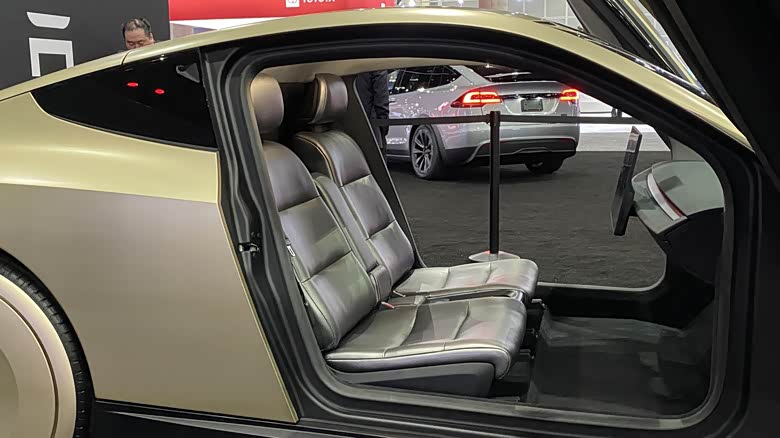
The Cybercab adopts a brand-new manufacturing process. The model's chief engineer Eric Early introduced at the launch event that the footprint of the production line can be reduced by 50% as a result, and when the production line operates at full capacity in the future, the vehicle production speed will be greatly increased.
Tesla once estimated that the Cybercab can travel 9.8 kilometers per kilowatt-hour of electricity, equivalent to an energy consumption of approximately 10.2 kWh per 100 kilometers. Benefiting from its extremely low energy consumption level, the travel cost of the Cybercab in the U.S. can be as low as 0.2 USD per kilometer, one-tenth of the industry average. Tesla has also designed wireless charging and automatic cleaning solutions to reduce the need for manual plugging and unplugging of charging guns and manual cleaning operations.
The above-mentioned performance and arrangements all help to reduce the operating costs of Tesla's driverless taxis. The company's head of vehicle software Sylvio stated at the launch event that the company plans to adopt a dynamic pricing strategy to balance vehicle supply and demand. As the number of Cybercabs increases, the average waiting time for customers will become shorter and shorter, and the pricing will also be very competitive.
Tesla has not yet announced the promotion timeline for the Cybercab, only stating that the Cybercab will gradually become the main model of Tesla's driverless ride-hailing fleet in long-term operations.
Tesla launched its driverless taxi service in June 2025. Before the mass production of the Cybercab, relevant services are provided by modified Model Y vehicles. Currently, the operating scope of Tesla's driverless taxis has expanded to eight U.S. cities and metropolitan areas, but the company has not disclosed the number of operating vehicles.
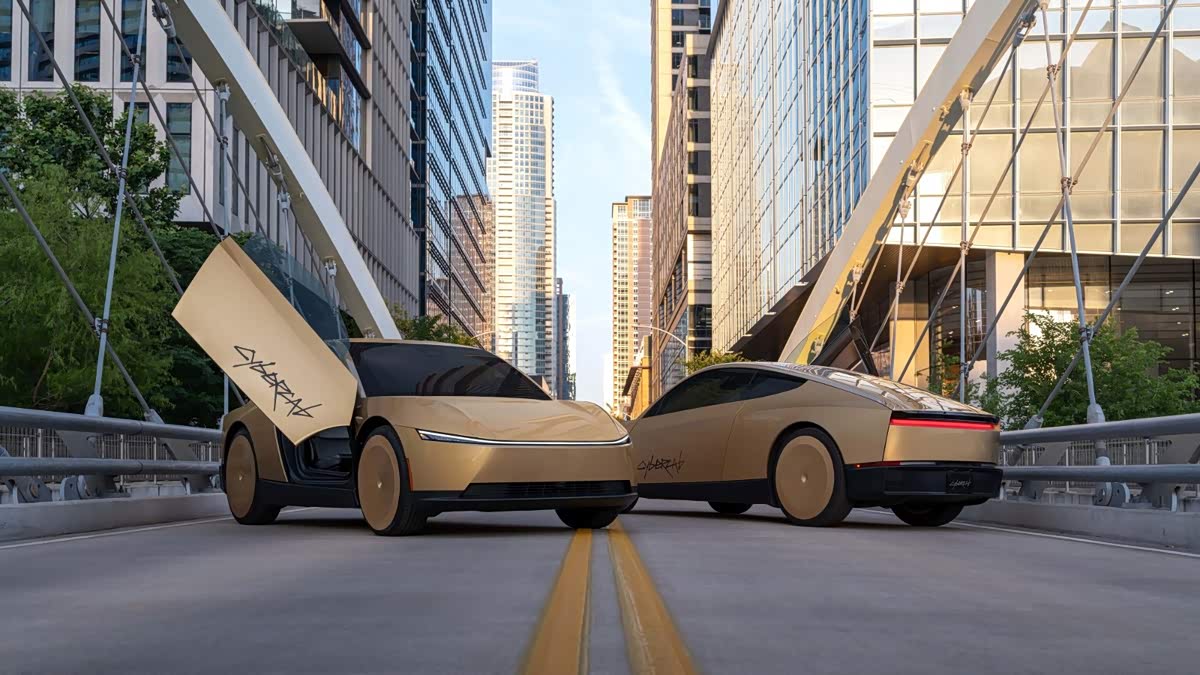
Tesla's large-scale promotion of the Cybercab still faces regulatory hurdles. The current U.S. Federal Motor Vehicle Safety Standards are formulated around human-driven vehicles and have not yet been revised for autonomous driving vehicles. The Cybercab is not equipped with traditional manual control components, such as brake pedals, accelerator pedals, steering wheels, and rearview mirrors, so it cannot fully meet the requirements of federal safety standards. To this end, U.S. regulators have arranged to allow 2,500 such vehicles to apply for exemptions each year.
For items under the Federal Motor Vehicle Safety Standards, the U.S. allows automakers to issue certifications on their own first, and then the U.S. National Highway Traffic Safety Administration (NHTSA) conducts investigations afterwards. Items of the Cybercab other than manual control components are implemented in accordance with the above regulations.
Therefore, on September 3, after Tesla unveiled the Cybercab, the NHTSA announced the launch of an investigation into it. This investigation aims to verify the processes, technical data, and other issues on which Tesla's certification of the Cybercab is based. The NHTSA will focus on evaluating the extent to which Tesla's certification work is based on the determination that "some Federal Motor Vehicle Safety Standards do not apply to the Cybercab".
In addition, the U.S. plans to formulate a unified autonomous driving act at the federal level to increase the annual number of exemptions to 90,000, but the legislative process is slow. Tesla needs to obtain regulatory approval from different U.S. state governments before the Cybercab can be put on roads on a large scale. Public information shows that Tesla has registered 45 Cybercabs in Texas; on August 20, Tesla obtained approval from Nevada, allowing it to deploy up to 5,000 autonomous driving vehicles in Clark County (including Las Vegas) within the next 12 months.
With the Cybercab entering operation, debates over different technical routes have once again emerged in the industry. A few days before the Cybercab launch event, Srikanth Thirumalai, Vice President of on-board software at driverless taxi giant Waymo, published a public article introducing the experience Waymo has gained from over 200 million miles of autonomous driving. He pointed out that multi-sensor fusion is indispensable: cameras can identify road signs and light colors, LiDAR can capture high-precision geometric shapes, and millimeter-wave radar can track speed and penetrate rain, fog, and dust. No single sensor can accomplish all these tasks at the same time.
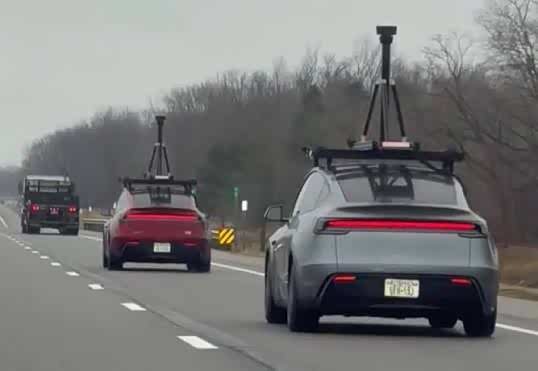
The article also stated that the end-to-end technical route relies entirely on neural network models. Although artificial intelligence is powerful, it is not magic. Neural network models cannot present the decision-making process, have the problem of black-box failures, and it is difficult to build trust.
The above article did not mention Tesla or the Cybercab, but Tesla has clearly stated multiple times that it will not use LiDAR, and its system adopts a pure vision solution that only uses cameras. Moreover, Tesla is the pioneer of the end-to-end architecture. The general public believes that Waymo is indirectly indicating that the Cybercab cannot realize autonomous driving.
Tesla's Vice President of AI Ashok Elluswamy stated at the launch event that Tesla has always believed that the core issue of autonomous driving is intelligence. The system needs to understand what is happening and predict what will happen in the future. No sensor in the world can predict the future; this must be judged by an intelligent agent, which then takes actions accordingly. The end-to-end architecture built by Tesla is designed to fundamentally solve this problem.
He also pointed out that humans drive all day long using "cameras" (eyes). This is not an invention of Tesla; Tesla only needs to find a way to replicate this system in a vehicle. Now the Cybercab has achieved this, and it will be an affordable and scalable autonomous driving solution.
Well-known U.S. investor Ross Gerber said in an interview with CNBC that the autonomous driving business has huge potential, but he is skeptical that autonomous driving will completely replace human drivers. He also pointed out that Waymo's actual performance is far better than Tesla's. Although the advanced driver-assistance system Tesla is currently rolling out is already very good, it is far from achieving full autonomous driving. "Tesla still has a lot of work to do, and compared with software, its shortcomings at the hardware level are more obvious," Ross Gerber said.
Which is superior, the LiDAR solution or the pure vision solution, is also a controversial topic in China. Currently, most enterprises tend to adopt the sensor fusion solution that includes LiDAR.
Domestic regulatory authorities have begun to revise relevant regulations to create conditions for autonomous driving vehicles to hit the road. Which technical route will ultimately prevail in the future remains to be tested by the market.